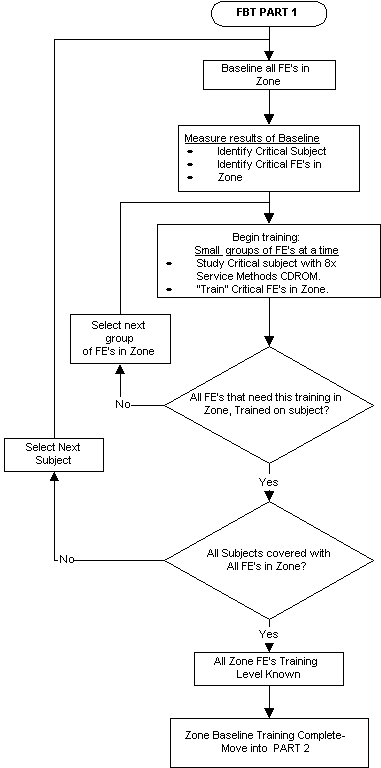
Give the Baseline questionnaire you have selected, to all FE's in attendance, WITHOUT THE AID of any support material provided. If you issue the questionnaire via e-mail, make sure you explain the purpose clearly: The intent of this "baseline questionnaire" is to determine what they know, without any support information. Recommendation: allow 1 week for FE to complete and return. This inital "baseline questionnaire" should take the FE approximately 5 minutes. Emphasize that any research done to answer the questions correctly, will be counter productive!
Critical Concept:
No support material must be used, in this step. To get an accurate measurable
comprehension level of the FE MR system experiences. You must stress the
absence of any support material. Failure to follow this rule will impact your
intended results and will lead you to train the wrong FEs or choose the wrong
subject to start your training effort!
STEP 3:
ANALYZE The Training Gap
[BACK][FORWARD]
Use the measurement tools to determine:
-
The top subject identified by questions that all FE's missed the most.
-
The FE's who have been identified to have the weakest training level.
This step will allow you to manage the FBT task in the Field by providing
you with the information you need to maximize your training task while
minimizing the effort! The point here is to start with small groups that will
eventually bring all the FE's in your Zone up to a unified level of
understanding.
The measurement tool is a Microsoft Excel Spreadsheet. I
recommend you take a copy of it and remove the colors. The color
coded version will help you understand how to use it. The
spreadsheet "How-To"
document will explain each section and reference the colors.
To find them:
Problems?
e-mail- Douglas.Hofstetter@med.ge.com
Indicate your Microsoft Excel Version. (Office 95, Office97)
STEP 4
IMPROVE Implement The Solution
[BACK][FORWARD]
Once you have identified the Critical Training need and the Critical FE's that need it most, you should execute the training process:
Start by studying the 8X Service Methods CDROM yourself. Once confident you know where to find the information:
- Organize a small group training session made up of Critical FE's identified by the measurement step.
- Introduce them to the current 8X service methods Troubleshooting flowcharts and currrent service documentation.
How to Train:
This can be a formal class you have developed, or a general discussion with the target FE's you have identified as the most critical. HOW you do this training class is up to you.
Suggestion:
- Use the Question Solutions on the FE Training Tools Page ( See left panel).
- Open up the website and select the questionnaire you have issued to your
FE's.
- Use that information flow to guide your FE's through the MR Service
Methods CDROM to FIND ALL the answers to the questions on the questionnaire.
- Follow-up with the presentation called "tsmethod.ppt". This presentation is an overview of Complex System Troubleshooting Methods. (Look for filename "tsmethod.ppt" in folder
"Support". Click on tsmethod.ppt it to open the Power Point 97 version.)
You are responsible to integrate this training process into your zones' "every day operation" . It should be based on the realities of your zone, (Size, Coverage, current installs, Current ZSE/FE workload etc.. etc..) and become part of the job. Many of you already do some form of Field wide communication. This could be presented as a "Subject of the week/Month/Quarter".
Note:
About the content of MR Service Methods CDROM:
It will become apparent that some of the documentation may not have the depth of subject you may need to complete the training to 100% satisfaction. When this occurs, you may have to use your experience to adequately explain the subject. You may also try to draw on local "expertise" within your Zone as well as other ZSE's and Service Engineering personnel. This is expected, and part of the "Trainer experience". No one is expecting the ZSE's to be EXPERTS on all subjects! Your job will be to perform training, and facilitate this training as best you can. |
Service Engineering/ZSE Feedback loop:
To improve the training material it is in your best interest to report this documentation deficiency to Service Engineering. Your feedback is critical to adding the information to the Service Methods CDROM. The CQA process and the new Service Engineering Bulletin Board (BBS) will be your feedback tools, as well as the bi-annual ETC/ and MAC Meetings.
|
STEP 5
IMPROVE The Training Deficiency Has Been Corrected
[BACK][FORWARD]
Once your training session has been completed, give the exact SAME Subject Questionnaire as the first baseline to all FE's in attendance. DIFFERENCE: This time, allow the FE's participating to use all available sources of documentation to answer the same questionnaire to 100% satisfactory.
STEP 6
CONTROL The knowledge level of the FE's
[BACK][FORWARD]
Allow for a follow up Feedback and Critique discussion and time to feedback documentation deficiencies to Service Engineering.
Repeat this process starting with the most critical FE's in the Zone, on each of the 8 subjects as defined by the Service Methods CDROM, ZSE_Support_Tools.
Questions & Answers:
[BACK]
Do I have to train ALL of the FE's in the Zone/LCT?
NO!
By measuring WHO needs the training and WHAT subjects are most problematic to
the FE's you will find it only necessary to train a few engineers in your Zone.
Measuring will help you identify and train only those that need it.
Why do I need a 100% response rate of all the FE's in my Zone/LCT?
If you don't, you will most likely be training everyone in your zone on every
subject. A huge task you don't have time for. If you understand the baseline
level of ALL FE's in your Zone/LCT you can then proceed in a methodical way to
train only those that need it.
My Zone training needs are different than other Zones. Why are we all
distributing the same Baseline questionnaire at this time, if our training
needs are different?
Because this particular Questionnaire was TESTED for effectiveness at the
October '99 ETC by all the ZSE's that were present. It also contains a question
about each of the eight subjects. The collective average score was 80%. This
told me you have the experience to train FE's on those particular target
questions. It also gave Service Engineering a broad understanding of the
training deficiencies across the field and will be emphasizing these training
issues with the Education Center MR Training team.
Note: You are encouraged to use the other questionnaires to
"baseline" your zone on the subjects identified. Eventually all of
them should be used in this process.
Most ZSE's already know who needs training and feel we don't need to measure
everyone.
"Gut Feel" is a great place to start. Unfortunately if you can't put
a measurement on it, you can't improve it. Your management runs on a
quantitative system. Resource allocation is based on "biggest impact with
limited funds". This is a business reality. This FBT effort gives you a
measurement that you can take to your manager, and PROVE that training and
document improvement is needed to drive overall Service Quality.
Do I need to develop a training module to train with?
NO!
You will not do this in PART 1. We need to raise all FE's to a known level
first, then perhaps in PART 2 we can identify and build Training Modules to
share among the zones.
Where do I get a Train The Trainer session on HOW to effectively Train?
You must take this to your management. If they expect you to train then, you
should be able to get this training through local means.
I'm too busy "firefighting" Signa problems right now to start this
FBT process.
If you don't make time to do this, you are locking yourself into a constant
firefighting loop. The intent is to start with small groups and improve your
zones/LCT training level a little at a time. Eventually their improved
expertise will relieve you of most of the firefighting that began as a small
issue, allowing you to concentrate on the chronic problems within your Zone/LCT.
The documentation does not have all the answers in it. How am I supposed to
train with such incomplete source material?
This is a reality. Problem is, Service Engineering does not know WHAT is
missing? And WHAT is important to your everyday work. The users have this
information and these deficiencies need to be reported to Engineering so we can
accelerate the improvement of this documentation! USE THE FEEDBACK LOOP (BBS
and CQA process)
I don't feel I know the subject well enough either? How can I deliver training
as an expert, if I don't feel confident in the subject?
You have now identified your training weaknesses as well. Formal classes did
not address this subject adequately or you have not been able to justify your
own training needs. Now's the time to work out a plan with your manager to get
the needed training.
Suggestion: Use other resources. We are all experts on a few things. Seek out
other ZSE's within your zone that has the expertise. Share the knowledge and
the training. Using this FBT process will help you get Service Engineering back
into the Field and perform this training session for you. Or
"Train-The-Trainer".
We've "Been there-Done-That" with FBT. Why is Service Engineering
forcing this issue again, when it was proven before that it doesn't work?
The term "FBT" and concept of Field Based Training has changed
dramatically. It can be as complicated and time consuming as a CBT program or
a formal class module, OR as simple as a re-introduction of the current
documentation that is presently accessible by every FE.
This is the goal of this "FBT". Re-introduce the documentation that
is presently available and
learn its strengths and weaknesses
. Support the weaknesses with local expertise (ZSE's) and share the strengths
with ALL FE's working on Signa. The ZSE Feedback will be the foundation to
improving the current documentation.
[BACK]